Lenga Maps
LENGA MAPS

Unmasking Africa with Data and Intelligence

The Lenga Atlas

Maps built from our data.

A small selection of cartography produced in-house — soil, terrain, water, energy, land tenure and climate finance — to show what becomes possible once the underlying data is in your hands.

01 · Lusaka, Zambia

Watershed Delineation & Drainage Analysis of Lusaka

Sub-catchment boundaries, drainage networks and pour points carved out of Lusaka's terrain, with the constituencies of Kabanana, Ibex Hill, Chilenje, Chalala and Lilayi pinned to the basin each one actually drains into. Every drop of rain falling on those neighbourhoods leaves the city through one of the green outlet points — get the watersheds wrong and the stormwater plan protects the wrong side of town. It is the foundation layer underneath every credible drainage, flood-risk and pollution-tracing study Lusaka can put together.

02 · Southern Africa & Madagascar

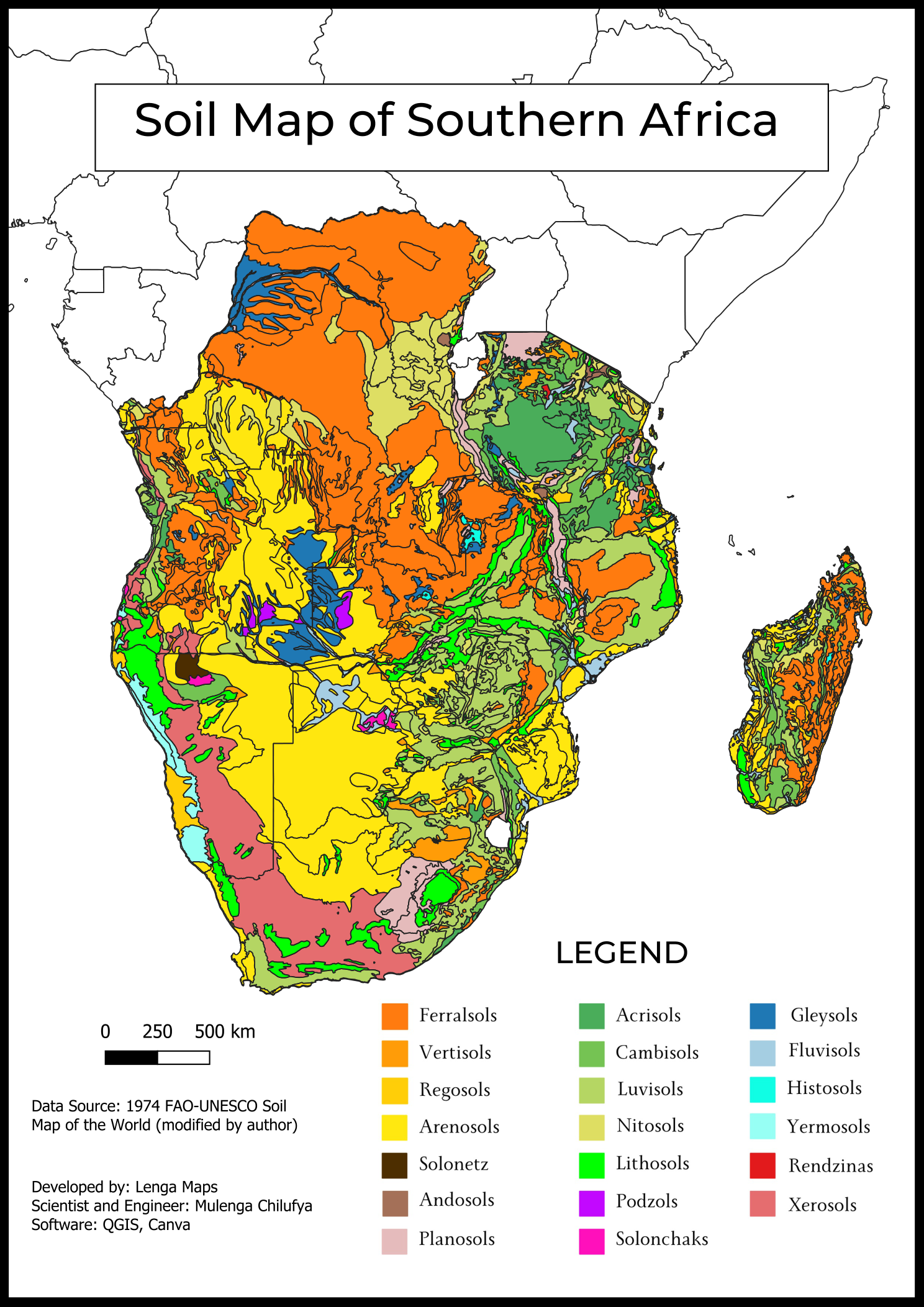
Soil Map of Southern Africa

More than twenty distinct soil orders — Ferralsols, Vertisols, Arenosols, Acrisols, Solonchaks and the rest — drawn out across the southern half of the continent and Madagascar in a single legible chart. Soil is the silent variable behind nearly every land question: which crop grows, where groundwater recharges, which slope holds a foundation, which forest can be replanted. A regional palette like this lets agricultural planners, hydrologists and engineers compare countries without having to stitch national datasets together themselves.

03 · Mining exploration site, Zambia

Basic 3D Profiling of a Mining Exploration Site

The same exploration block rendered three ways — true-colour satellite drape, hillshaded surface and false-colour elevation — so the terrain can be read structurally instead of guessed at. Before a single rig moves, slope, drainage and ridge orientation decide road access, pad locations, runoff direction and where the ore body is most likely to surface. A 3D profile turns a flat polygon on a licence map into something a geologist, a civil engineer and a financier can argue about from the same picture.

04 · Zambia

Digital Elevation Model of Zambia

A continuous elevation surface across all of Zambia — from the warm green of the Zambezi floodplains in the south to the deep ridges of the Muchinga Escarpment in the north-east — with wetlands and the country's major lakes called out in blue. Zambia is often described as a flat plateau, and at country scale that is almost true; but the variation that does exist is exactly what governs soil formation, ecological zonation and the direction water moves on the landscape. Every serious agricultural, hydrological or infrastructure plan in the country starts on a layer that looks like this.

05 · All of Africa

African Carbon Credits Produced, 2017–2023

A continental view of who is actually generating carbon credits in Africa across the 2017–2023 window: the Democratic Republic of Congo and Kenya pull furthest ahead, followed by Zambia, Zimbabwe and South Africa, while most of the continent still measures in single megatons. Carbon credits are now one of Africa's fastest-growing climate-finance flows, and a single map immediately surfaces which countries have built project pipelines and which haven't. It is the kind of view investors, NGOs and climate-policy desks reach for first when sizing where the next decade of forestry and energy-transition money is going to land.

06 · Kalumbila / Solwezi, North-Western Province, Zambia

Boundary Mapping for a Mining Exploration Area

A formal survey of a 101-hectare exploration block sitting between Kalumbila and Solwezi, with every beacon labelled A through F, every leg ticked with its distance, and the anchor point captured in WGS84 / UTM Zone 35S. Mining licences in Zambia don't live as screenshot polygons — they live as legal documents with named beacons, bearings and a fixed coordinate, and the regulator wants exactly this format. The locator insets bolt the parcel to its district and to the country, so anyone can place it without ever opening a separate map.

07 · Zambia

Photovoltaic Power Potential of Zambia

Long-term solar-irradiance potential across Zambia averaged over 1994–2017, with national parks and the main road network laid on top so each cell can be read against access and protection constraints. Western and Southern Provinces register some of the strongest solar numbers anywhere on the continent — comfortably above what most of Europe ever sees — while the wetter north sits a step below. For a country still building out its energy mix, a map like this is where utility-scale PV siting, mini-grid planning and rural-electrification economics all begin.

Want to make maps like these?

Every layer behind these visuals — terrain, soil, hydrology, land cover, climate, infrastructure — is downloadable from the Lenga Maps catalogue. Bring the data into QGIS, ArcGIS or your tool of choice and the next map is yours.

Browse the dataset catalogue